Imperial cities · Fez-Meknes
Fez
also Fès, Fez, فاس
34° 02′ N · 5° 00′ W
Fez is the capital of the Fez-Meknes region. Its medina has been on the World Heritage List since 1981 and, in UNESCO's assessment, is one of the most extensive and best-preserved historic towns of the Arab-Muslim world.
Open on the mapopens the map at this spot
Location
Fez is the capital of the Fez-Meknes region, which, besides the prefecture of Fez, comprises the prefecture of Meknes and seven provinces. In the 2024 census the municipality of Fez had 1,167,842 inhabitants, 49,775 of them in the Fès-Médina district; the prefecture as a whole had 1,256,172. In its national overview the Haut-Commissariat au Plan gives the city around 1.18 million inhabitants, ranking it third after Casablanca and Tangier.
History
The city goes back to the Idrisids, who laid it out between 789 and 808. The ICOMOS evaluation of 1981 gives 808 as the year of foundation and Idris II as the founder. Originally Fez consisted of two quarters on either side of the Oued Fès: settlers from Córdoba established themselves on the right bank, families from Kairouan on the left, and each quarter grew up around its main mosque, the Andalusian Mosque and the Qarawiyyin. In the 11th century the Almoravids enclosed the city within a single wall, and under the Almohads Fez el-Bali reached its present extent.
The city reached its height in the 13th and 14th centuries under the Marinids, when it replaced Marrakesh as the capital; most of the medina's madrasas, fondouks, palaces, mosques and fountains date from this period. In 1276 Sultan Abu Yusuf founded the new town of Fez el-Jdid west of the old town, with a royal palace, a military camp and residential quarters. In 1912 the role of capital passed to Rabat; Fez is still regarded today as the country's cultural and spiritual centre.
Landmarks
The medina of Fez was inscribed on the World Heritage List in 1981 under criteria ii and v. The site covers 280 hectares, including the entire urban fabric and the walls; the buffer zone goes back to decrees of 1923 and 1954. Since 2001 there has been a development plan for the medina, reviewed every ten years, and a dedicated agency is responsible for restoring houses and monuments.
The Qarawiyyin Mosque stands by the spice market, Souk el-Attarine. According to Archnet, Fatima al-Fihri, the daughter of a merchant who had moved from Kairouan, endowed it in 857 as a private place of prayer; in the 10th century it became the Friday mosque of the quarter. The Almoravid Ali ibn Yusuf enlarged it to its present size between 1134 and 1143, and the two fountain pavilions in the courtyard were built on the orders of the Saadian Abdallah ibn al-Shaikh in the early 17th century. Guinness World Records dates the founding of the University of al-Qarawiyyin to 859 and lists it as the oldest existing, continually operating educational institution in the world.
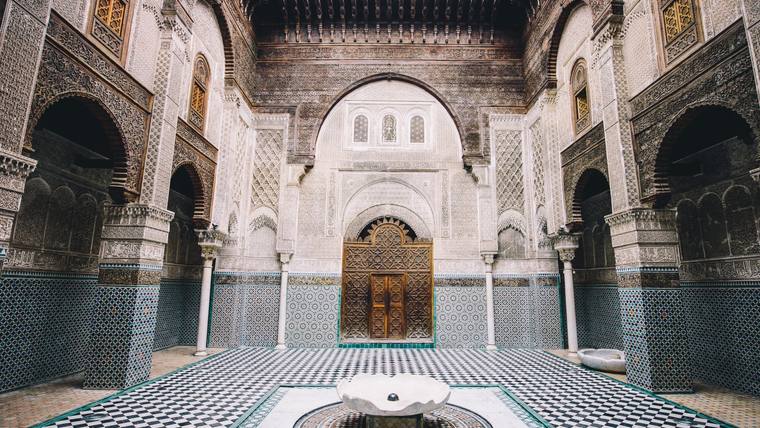
The Bou Inania Madrasa bears the name of its founder, the Marinid sultan Abu Inan; Archnet dates it to the years 1350 to 1357. It was both a school and a Friday mosque, has its own minaret, and its water clock also set the prayer times for other mosques in the city. The marble-paved courtyard is decorated with tiled dados, carved wood and stucco, and wooden screens separate it from the corridors leading to the students' rooms.
Culture
UNESCO associates the medina of Fez with three elements of intangible cultural heritage: Arabic calligraphy, engraving on gold, silver and copper, and malhun. Malhun is a popular form of poetry sung in Arabic dialect and accompanied by lute, violin, rebab and small drums; UNESCO added it to its Representative List in 2023. Metal engraving followed in the same year, jointly submitted by ten Arab states including Morocco.
Since 1994 the Esprit de Fès foundation has organised the Fes Festival of World Sacred Music, complemented since 2001 by a forum. In 2001 the United Nations described the festival as a contribution to the dialogue between cultures; the organisers count 27 editions.
Getting there
Fez lies on the A2 motorway from Rabat to Oujda: the section from Meknes to Fez has been open since April 1998, the 320-kilometre stretch from Fez to Oujda since July 2011. At the Fès-Saïss weather station, at 571 metres, the mean daily maximum is 35.1 °C in July and August and 16.0 °C in January. Some 488 millimetres of precipitation fall there in a year, in July on average barely more than one millimetre (1991–2020 mean).
In brief
- Region
- Fez-Meknes, seat of the region
- Population
- 1,167,842 (municipality of Fez, 2024)
- Founded
- between 789 and 808 under the Idrisids
- World Heritage
- Medina of Fez, since 1981
- Motorway
- A2 from Rabat via Fez to Oujda
Months with a mild climate
February, March, April, May, October. Months with average daily highs between 17 and 30 °C and less than 60 mm of rain; Fès-Saïss (WMO 60141, 571 m, 1991–2020).
Pass on
Send this place to family and friends or copy the link.
Nearby
- Sefrou28 km · Imperial cities
- Moulay Idriss48 km · Imperial cities
- Meknes53 km · Imperial cities
- Ifrane58 km · Imperial cities
- Azrou70 km · Imperial cities
- Taza93 km · Imperial cities
- Ouezzane100 km · North
- Targuist119 km · North
As the crow flies, not road distance.
Checked on 24 Oct 2026. Every number in the text opens its source.