Centre · Marrakesh-Safi
Marrakesh
also Marrakech, Marrakesh, مراكش
31° 38′ N · 7° 59′ W
The Almoravids founded Marrakesh in 1070–1072, its medina has been on the World Heritage List since 1985, and Jemaa el-Fna square is part of the Intangible Cultural Heritage of Humanity.
Open on the mapopens the map at this spot
Location
Marrakesh is the capital of the Marrakesh-Safi region, which, besides the prefecture of Marrakesh, comprises the provinces of Al Haouz, Chichaoua, El Kelâa des Sraghna, Essaouira, Rehamna, Safi and Youssoufia. In the 2024 census the municipality of Marrakesh had 1,002,697 inhabitants and the prefecture as a whole 1,571,580. The city's weather station lies at an altitude of 464 metres; the long-term average there is 221 millimetres of precipitation a year.
History
Marrakesh was founded between 1070 and 1072 by the Almoravids, who ruled from 1056 to 1147; their successors, the Almohads, made the city their capital until 1269. For a long time it was a political, economic and cultural centre of the western Islamic world, with an influence reaching as far as al-Andalus. The Moroccan empire was named after the city, and Fez el-Jdid, the new town of the Marinids, follows the older urban model of Marrakesh in UNESCO's assessment.
Landmarks
The medina has been on the World Heritage List since 1985 under criteria i, ii, iv and v; the inscribed area covers 1,107 hectares. The old town itself occupies around 700 hectares and is bounded by the original city walls and their gates. Within them lie lanes, houses, souks and fondouks; the protected surroundings include the Agdal and Menara gardens and the palm grove, whose layout is attributed to the Almoravids.
The city's landmark is the Koutoubia Mosque with its 77-metre minaret. The Almohad caliph Abd al-Mu'min founded the mosque in 1147 and had it completely rebuilt around 1158; the minaret was probably completed around 1195. Its name comes from the Arabic word for booksellers, who plied their trade in the neighbouring souk.
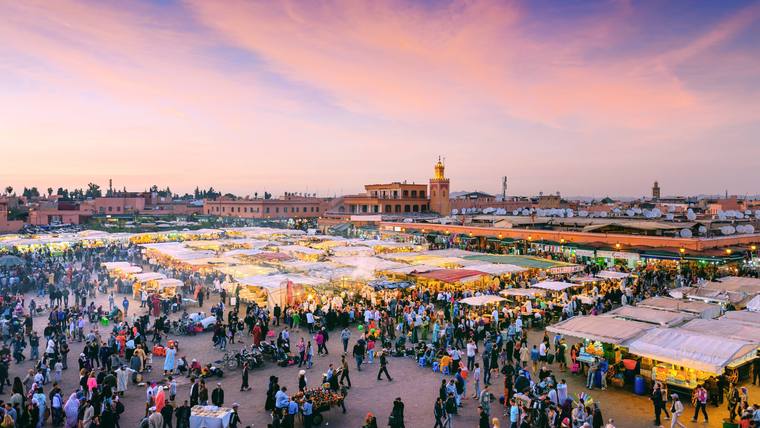
Jemaa el-Fna square lies at the entrance to the medina and has been a symbol of the city since the 11th century. UNESCO proclaimed it a cultural space of intangible heritage in 2001; since 2008 it has been on the Representative List. What is recognised is not buildings but practices: storytellers and poets, musicians and Gnawa dancers, snake charmers, as well as henna painting, food stalls and traditional medicine. In the former State Bank branch on the square, a building from 1922, a museum of the Fondation nationale des musées now tells the story of the square and of the halqa, the storytelling circle.
From later periods UNESCO names, among others, the Badi Palace, the Ben Youssef Madrasa, the Saadian Tombs and the Bahia Palace. The madrasa was built on the orders of the Saadian sultan Abdallah al-Ghalib; an inscription dates it to 1564/65. Around its courtyard lie 130 student rooms; the school closed in 1960 and opened as a historic monument in 1982. The Saadian burial complex on the south side of the Kasbah Mosque was enlarged under Ahmad al-Mansur (reigned 1578–1603) and rediscovered in 1917 by the monuments service; its main hall, the Chamber of the Twelve Columns, is al-Mansur's mausoleum.
Because traditional materials are used in restoration work in the medina, the building crafts have, according to UNESCO, been given a new lease of life: zellige, tadelakt plaster, painted and carved wood, stucco and wrought iron. The crafts of the region are shown at the Dar Si Saïd museum, a town palace from the second half of the 19th century, built for Si Saïd Ben Moussa, minister of war under Sultan Moulay Abdelaziz (1894–1908). Since 1930 the house has been devoted to the arts; today it is the national museum of weaving and carpets, with pieces from the High Atlas, the Souss and the Tafilalet.
Getting there
According to the airport operator ONDA, Marrakesh-Menara airport handled 10,197,736 passengers in 2025, up from 9,263,261 in 2024. On 24 April 2025 construction began on the high-speed line from Kenitra to Marrakesh: some 430 kilometres of new line, designed for 350 kilometres per hour.
In brief
- Region
- Marrakesh-Safi, with Marrakesh as its capital
- Population
- 1,002,697 in the municipality, 1,571,580 in the prefecture (2024)
- World Heritage
- Medina of Marrakesh, since 1985
- Intangible heritage
- Cultural space of Jemaa el-Fna square, on the Representative List since 2008
- Airport
- Marrakesh-Menara, 10,197,736 passengers (2025)
Months with a mild climate
January, February, March, April, May, October, November, December. Months with average daily highs between 17 and 30 °C and less than 60 mm of rain; Marrakech (WMO 60230, 464 m, 1991–2020).
Pass on
Send this place to family and friends or copy the link.
Nearby
- Asni42 km · Centre
- Imlil55 km · Centre
- Chichaoua75 km · Centre
- Youssoufia86 km · Centre
- Aït Ben Haddou104 km · South-east
- Ouarzazate126 km · South-east
- Safi140 km · Centre
- Skoura150 km · South-east
As the crow flies, not road distance.
Checked on 24 Oct 2026. Every number in the text opens its source.